.png)
Three Forward, Two Back

A two-day dispatch from the shop, the trailer lot, and everywhere in between.
Some build days are clean. You execute, you measure, you weld, and the car is measurably better when you leave than when you arrived. Then there are days like this week — where the learning is real, the work is hard, and the magic smoke escapes at least once. We’ll take both kinds.
Day One: CAN Bus, Wiring, and a Steering Rack Installed Upside Down
Penguin and Gino spent the better part of the morning trying to establish communication with the battery’s BMS over CAN. They fabricated a custom RJ-45 connector and used the serial adapter that shipped with the battery to pull telemetry — voltage, state of charge, cell-level data. It didn’t work. A CAN sniffer was ordered, arrived, and also didn’t cooperate. This is the kind of problem that feels like a wall but is actually just a locked door. We’ll find the key.
Meanwhile, the steering wheel controls project hit a real milestone — and then a wall of its own making. The concept is solid: use a single wire with resistor-divided voltage levels to encode multiple steering wheel functions (horn, turn signals, battery voltage check) and decode them with an Arduino, bypassing the need for a clock spring entirely. The brake light integration was coming along. Then twelve volts went into the 5V output side of the buck converter. Immediate sizzling. Then the magic smoke. Component loss noted, lesson reinforced.
The real story of Day One was in the steering geometry. Crouton and Alex identified that the Ackermann angle was too aggressive — the inner wheel was turning far more sharply than needed, which would cause scrubbing and unpredictable handling. The fix: move the rack back toward the knuckle arm centerline, which required shortening the steering shaft and re-cutting the tie rod lengths to match. Real geometry work — measuring, recalculating, cutting chromoly, re-threading rod ends, verifying toe and bump steer across the full range of motion.They got it tack welded in. Then discovered the steering rack had been installed upside down. Turn right, wheels go left.
By the end of Day One, we had not driven the car. We had, however, learned an enormous amount. That counts.
Day Two: The Trailer, MIT’s Gemini, and a Gas Can Full of Diesel
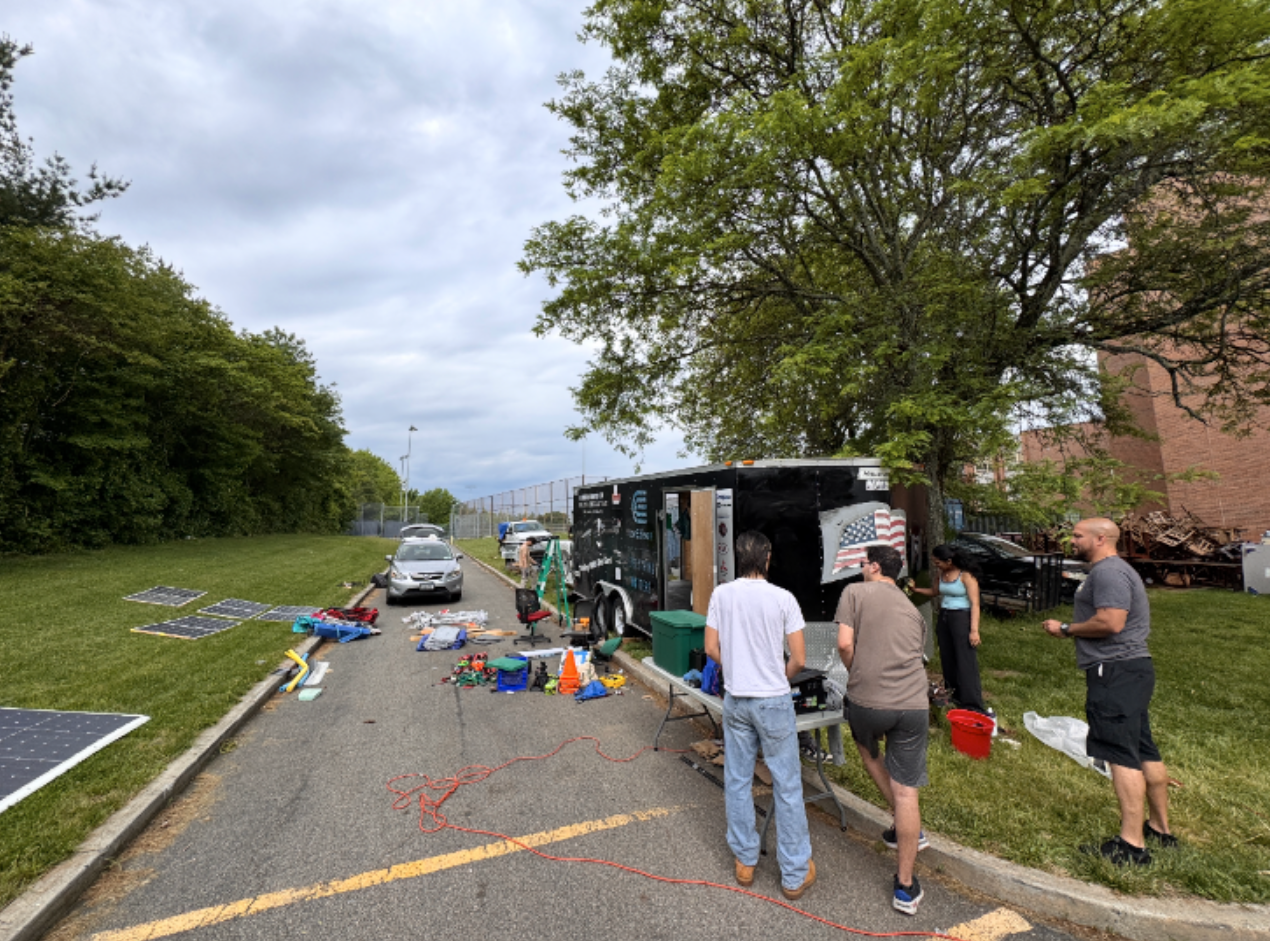
The plan had been to load the car on the small trailer and take it to Susan Wagner or Staten Island Tech to work on it, since McKee was closed Wednesday for Eid. But with the front geometry still unresolved after the upside-down rack discovery, the car wasn’t ready to move. So we abandoned that plan entirely and pivoted — the day became about the enclosed trailer: cleaning it up, pulling old sponsor graphics, buffing it out, and getting organized.
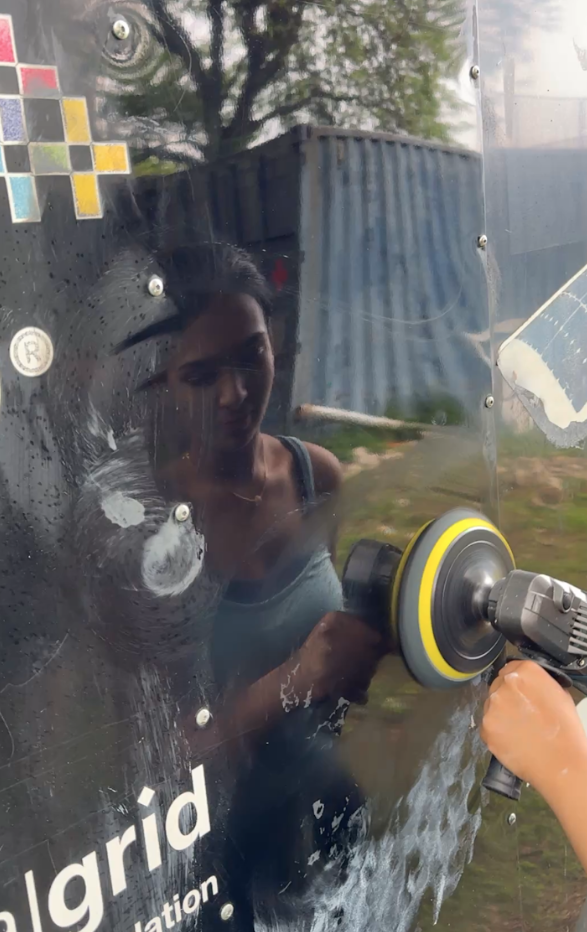
Susan Wagner High School has been a genuinely great partner to this program. Mr. Habib gave us access to their parking lot, tools, and space to work. We pulled the old sponsor graphics, got out the heat guns and buffing compounds, and went to work. Nathuli and Cristina trained up on the buffer and absolutely delivered — the trailer came out with a mirror finish. It looks like a different vehicle.
The Honda generator was running the heat guns and vacuum when it ran out of fuel. A custodian brought out a gas can. That gas can contained diesel. The generator inhaled it, stalled, and sat there. We drained the bowl, purged the carburetor, let it clear, and got it running again. No permanent damage. Add “field carb flush” to the team’s growing skill set.
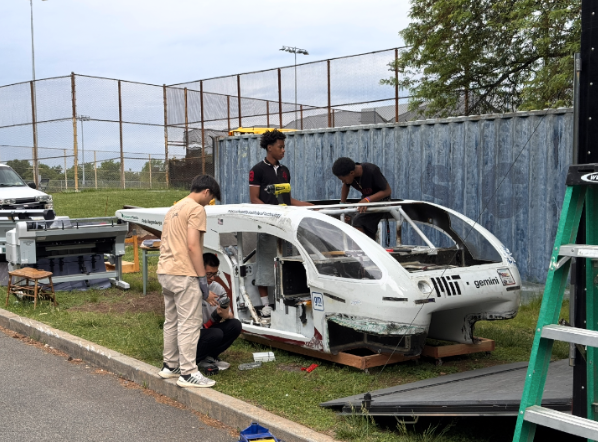
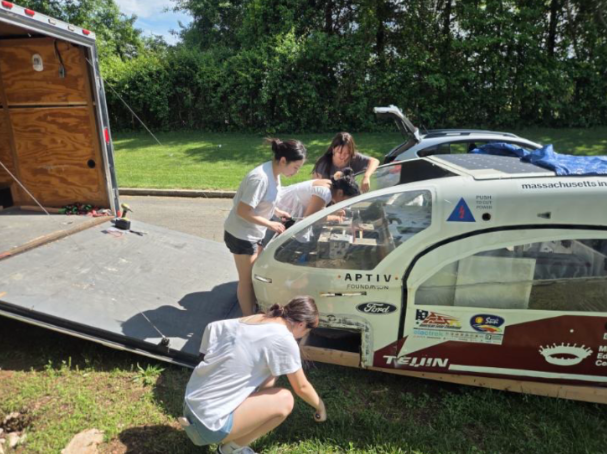
The bigger win of the day was the Gemini car from MIT. We pulled the solar array off it, tested each panel’s voltage output, and documented what we have to work with. We also removed a significant amount of hardware — brackets, mounts, connectors, fasteners — that we’ll repurpose directly on our build. Studying how MIT’s team constructed Gemini was its own education. A lot of custom machining. A lot of intentional design choices at the component level. That’s aspirational for us — and a concrete goal for next year’s build.
We also finalized our approach to the body. We’ve admired how Raisebeck Aviation High School builds their shells: carbon fiber over rigid foam insulation board, the kind you can get at any Home Depot. Light, stiff, cheap, and it works. We’re going that direction. The composite panels are ordered, and we have a mounting plan worked out to connect the shell to the chassis cleanly.Then the sky opened up. We scrambled to cover and stow everything, got soaked, and called it.
What We’re Carrying Into Tomorrow
The steering rack is correctly oriented now. The CAN sniffer just needs the right configuration. The body panels are on order. The trailer is ready to represent. We have hardware off a car built by MIT, and we’re studying it like the technical document it is.
Two days that felt like three steps forward and two steps back. But we’re still a step ahead of where we started. The car will drive. The BMS will talk. The shell will go on.
Can’t wait to hit it again tomorrow.


Project Manager:
Thomas Smolka
Email:
seagullsolarsi@gmail.com
Telephone:
718-614-4835
Address:
101 Belmont Pl, Staten Island, NY 10301